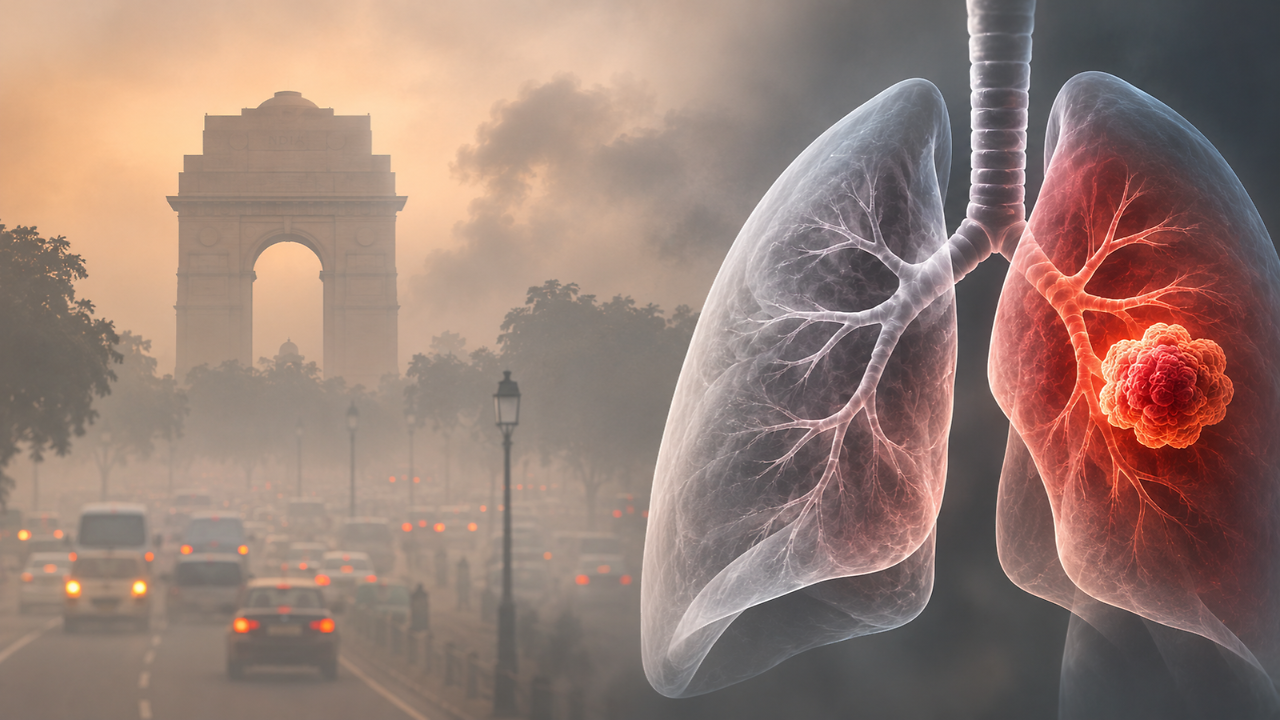
Delhi's worsening air pollution has sparked concerns about long-term respiratory and cancer risks. Newly revealed data from a few hospitals nod in this direction as there has been a visible increase in lung cancer cases and deaths. Since 2020, Delhi has seen one lung cancer death every three days, according to data obtained through Right to Information (RTI) from four prominent hospitals in the capital.Around 83 lung cancer cases were recorded every month across these hospitals in the last six and a half years. Three of these hospitals recorded more than 6,500 patients battling lung cancer during this period. Lung Cancer Cases Across Prominent Hospitals In DelhiAlso read: Can Delhi's Poor AQI Levels Increase The Risk Of Heart Attacks Even In Healthy Individuals? The data covers the period from January 1, 2020, to July 31, 2026. The RTI data, provided by renowned hospitals like AIIMS, Ram Manohar Lohia (RML) Hospital, Safdarjung Hospital and the Delhi State Cancer Institute, showed that 6,581 cases of lung cancer were registered at three hospitals. Safdarjung disclosed only deaths due to lung cancer, not the total number of cases.Across all four hospitals, 913 deaths were reported, translating to approximately one death every three days.While the data reveals the burden of lung cancer at some of Delhi's major public hospitals, they do not establish a causal relationship between the number of cases or deaths that were directly caused by air pollution. The data also does not provide a complete picture of lung cancer among Delhi's population.Individually, AIIMS reported the highest number of lung cancer cases, recording 4,860 patients between January 2020 and March 2026. The hospital also reported 158 deaths during this period, averaging around 65 cases and two deaths every month.The Delhi State Cancer Institute recorded 1,613 lung cancer cases in the six and a half years, along with 354 deaths. The institute also reported that 351 women were diagnosed with lung cancer during this period, while two children were diagnosed with the disease in 2021.RML Hospital reported 108 lung cancer cases, including 47 women, and eight deaths.Safdarjung Hospital reported 393 deaths due to lung cancer but did not provide the total number of lung cancer cases during this period.However, the hospitals serve patients from Delhi as well as neighbouring states like Uttar Pradesh, Haryana, Bihar and even Nepal, which means the figures cannot be interpreted as deaths among Delhi residents alone.Dr. Amish Vora, Senior Consultant - Medical Oncology, PSRI Hospital & H.O.P.E - New Delhi told HealthandMe, "Lung cancer cases in Delhi are rising due to a combination of tobacco use, passive smoking, long-term exposure to polluted air, occupational pollutants, ageing and improved detection. PM2.5 can penetrate deep into the lungs and contribute to cancer-causing cellular damage; however, pollution is one risk factor, not the sole explanation and population increase and aging might play a role here as well in numbers."Lung Cancer Diagnosed In People Who Never SmokedAlso read: Why Are Indian Men More Vulnerable to Lung Cancer Than Women? Understanding the Gender GapLung cancer is often linked with smoking, but it can develop in people who have never smoked. Doctors have reported lung cancer among non-smoking women. They also said that genetic factors and environmental exposures can also be possible contributors. A senior doctor from the Delhi State Cancer Institute (DSCI), spoke to PTI and said smoking and tobacco exposure smoke remain major causes of lung cancer, while genetic mutations also contribute.Dr Janki Choudhary, Consultant - Medical Oncology, American Oncology Institute, Gurugram told HealthandMe, "Yes. Hospital records show a steady rise in Delhi's lung cancer burden, with major government hospitals logging over 6,500 cases in just over six years. Crucially, nearly 50% of patients today are non-smokers, compared to only 10% in the late 1980s."Air Pollution And Lung Cancer Risk Delhi's air pollution is a major annual public health concern, which peaks during winter. During winter months, fine particulate matter remains trapped close to the ground. Long-term exposure to air pollution is an established risk factor for lung cancer.The International Agency for Research on Cancer (IARC), part of the World Health Organization (WHO), classifies outdoor air pollution and particulate matter as carcinogenic to humans.Dr Choudhary said, "In Delhi, lung cancer is no longer just a smoker’s disease. We are seeing a clear, troubling surge in younger patients and lifelong non-smokers presenting with advanced disease, paralleling the city's severe air pollution." Fine particulate matter such as PM2.5 can penetrate deep into the respiratory tract and contribute to cellular damage linked with cancer risk.Dr Choudhary added, " Fine particulate matter is a proven Group 1 carcinogen that penetrates deep into the lungs and causes DNA mutations similar to smoking. Breathing heavily polluted air year after year puts even lifelong non-smokers at a significant risk."A 2024 study published in the Royal Society of Chemistry journal Environmental Science: Atmospheres analysed Delhi's air quality between January 2019 and December 2023, assessing six pollutants, including PM2.5, PM10, nitrogen dioxide, ozone, benzene and toluene.Its health-risk assessment ascertained a risk of 1.51 for lung cancer mortality due to long-term PM2.5 exposure in Delhi, stating a modelled impact of 33.61 per cent.Another Delhi-based study, published in the Environmental Claims Journal in 2023, examined PM2.5 exposure between 2015 and 2020, including during November's smog episodes. It calculated an average risk of 2.15 for lung cancer mortality due to PM2.5 exposure.Dr. Vora explained further, "Prolonged exposure to air pollution, especially fine particulate matter (PM2.5), increases the risk of developing lung cancer even in non-smokers. In 2025, there was a systematic review and meta-analysis of more than 7 million non-smokers that showed that each 10 µg/m³ increase in long-term PM2.5 exposure is associated with 21% greater risk of lung cancer development. These particles get deeply inhaled into the lungs, cause chronic inflammation and cellular damage."